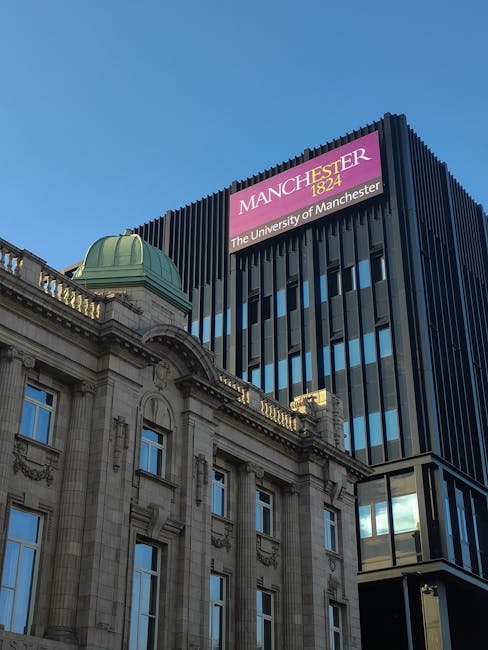
Understanding the true cost of a University of Manchester degree matters well beyond the headline tuition figure. For the 2024–25 academic year, international students face a layered set of expenses shaped by subject banding, accommodation choices, visa requirements, and optional study add-ons. Data from the University’s published fee schedules, UK Visas and Immigration (UKVI) maintenance rules, and the Higher Education Statistics Agency (HESA) all feed into a more complete financial picture — one that moves past averages and into what different cohorts of non‑EU learners will actually pay.
Undergraduate Tuition Banding for 2024–25
Manchester structures full-time undergraduate tuition for international students into a three‑band framework that reflects the delivery cost of each subject group. The band thresholds for 2024–25 entry, confirmed by the University’s central admissions documentation, sit as follows:
-
Band 1 (classroom-based subjects): £24,500–£26,600
Programmes such as History, Politics, English Literature, and Sociology fall here. The lower end of the range applies to disciplines with minimal specialist facilities; the upper end covers those that blend classroom teaching with some digital labs or field work. -
Band 2 (laboratory-based subjects): £28,000–£31,500
This band captures most Science and Engineering courses — Chemistry, Physics, Computer Science, Mechanical Engineering. Small variations within the band account for consumables and the intensity of lab access. A BEng in Electrical and Electronic Engineering, for instance, is priced at £30,500 for 2024‑25, while a BSc in Environmental Science sits at £28,500. -
Band 3 (clinical subjects): £44,000–£48,000
Medicine (MBChB) and Dentistry (BDS) occupy this tier, with the MBChB international fee fixed at £46,000 per annum for most entrants. Dentistry tracks slightly lower at £44,500, reflecting a different clinical contact ratio. For students entering the 6‑year medical programme that includes a foundation year, the initial year is charged at the Band 2 rate before the clinical premium applies.
Integrated master’s degrees (MEng, MSci, MPharm) continue the banding logic across all four years, so a student reading a four‑year MEng Chemical Engineering will pay the Band 2 rate for each year of the programme, not just the undergraduate portion.
Postgraduate Tuition: Taught and Research Pathways
Non‑EU postgraduate fees at Manchester are not regulated by a central banding system in the same way as undergraduate degrees, but clear pricing corridors have developed across the portfolio for 2024–25.
Taught Master’s Programmes
The broad range for international students spans £23,000 to £38,000, with business‑facing and laboratory‑intensive degrees commanding the upper segment:
- Humanities and some social science MA programmes (e.g. MA International Relations, MSc Public Policy) cluster between £23,000 and £27,000.
- Science and Engineering MSc courses — such as MSc Advanced Materials or MSc Data Science — typically fall between £28,000 and £35,000.
- The full‑time MBA at Alliance Manchester Business School is priced separately at £48,000 for the 18‑month intake commencing in September 2024, placing it among the highest‑fee taught programmes at the University.
- Certain specialist master’s degrees with extensive clinical or studio components, such as MSc Audiology or MArch Architecture, fetch £32,000–£38,000.
Part‑time and online variants attract pro‑rata rates. A two‑year part‑time MA in Education Leadership, for illustration, charges half the full‑time annual rate each year, plus a small administration uplift.
Postgraduate Research Fees
Doctoral and MPhil programmes track the laboratory/classroom split more closely. Bench‑fee subjects — those consuming significant laboratory resources — are grouped in a higher band, while desk‑based research is billed at a lower rate. For the 2024–25 academic year:
- Classroom‑based PhDs (Arts, Humanities, Law, Business & Management) are charged £22,000–£25,000 per annum.
- Laboratory‑based PhDs and those with high consumable demand sit between £28,000 and £34,000. A PhD in Biological Sciences, for example, carries an annual fee of £31,000, and a PhD in Chemical Engineering reaches £33,500.
- Clinical research degrees, such as the Doctor of Medicine (MD), are priced at £31,000–£36,000.
Research students commonly register for a writing‑up year at the end of their funded period, which attracts a reduced continuation fee of approximately £2,000–£4,000 for the 12‑month term.
The Cost of Optional Study Abroad and Placement Years
Many Manchester undergraduate programmes offer a study‑abroad year or a professional placement year. The fee treatment differs markedly between the two.
Professional placement year (optional, Year 3 of a 4‑year course):
The University caps the international fee for a full‑year work placement at 20% of the standard annual tuition fee. For a Band 2 laboratory subject, this translates to roughly £5,600–£6,300 for the placement year. The student remains registered at Manchester while on placement, retains access to university support services, and the reduced fee reflects the absence of formal teaching.
Study‑abroad year (integrated exchange, Year 3 of a 4‑year Languages or combined honours course):
Manchester participates in bilateral exchange agreements — notably through the Worldwide Exchange programme — that typically require the student to pay full Manchester tuition for the year abroad while the host institution waives its own tuition. In instances where a partner charges a tuition fee, Manchester may adjust the charge downward, but the default cost for international undergraduates remains at the home‑band rate. This means a student on a BA Modern Languages with a mandatory year at a partner university will pay the Band 1 fee (e.g. £25,000) for the year, not a reduced sum.
For medical and dental electives abroad, short‑duration study placements do not carry separate fees beyond standard tuition, but students self‑fund travel, accommodation, and visa costs.
Accommodation Costs: University Halls versus Private Rental
Manchester’s housing market offers distinct price layers by location and type. The University operates 19 halls of residence, with international undergraduates guaranteed a room in university accommodation provided they apply by the relevant deadline.
University‑managed halls (2024–25 weekly rates, 42‑week contract):
- Fallowfield campus halls (Owens Park, Oak House, Sheavyn House): £126–£174 per week for a single standard room with shared facilities; en‑suite rooms reach £193 per week. Woolf Hall, newly refurbished, sits at the top of this bracket.
- City campus halls (Whitworth Park, Denmark Road, Horniman House): £157–£218 per week, driven by closer proximity to academic buildings and newer developments such as Unsworth Park.
- Victoria Park area (mixed self‑catered): £149–£185 per week.
Grocery, utility, and internet costs are typically included in hall rents, so the sticker price represents a near‑complete housing bill.
Private rental sector (12‑month contract typical):
Students who move into shared houses or apartments after their first year encounter different pricing norms:
- Fallowfield / Withington shared house: £105–£135 per person per week (excluding utilities). A double room in a four‑bedroom terrace on Egerton Road tends toward £110–£120 pw. Bills add approximately £15–£25 pw.
- City centre apartment (Deansgate, Northern Quarter, Salford Quays fringe): £185–£260 per week for a one‑bedroom apartment; a bedroom in a shared luxury two‑bed averages £150–£190 pw before bills.
HESA’s Student Accommodation Costs Survey 2023 placed the median private‑sector rent for Manchester students at £146 pw, but 2024‑25 inflationary pressure has pushed the realistic lower bound in popular wards closer to £125 pw for a room in a shared house.
Living‑Cost Floor and the UKVI Maintenance Requirement
UKVI sets a fixed maintenance threshold that international students must demonstrate for visa purposes. For any institution outside London, the figure is £1,023 per month for living costs, covering accommodation, food, transport, and sundries. Over a nine‑month academic year, this totals £9,207. Manchester falls firmly in the “rest of the UK” category, meaning the Inner London rate of £1,334 per month does not apply.
The official UKVI requirement acts as a minimum solvency check; actual spending patterns are higher. The University’s own cost‑of‑living guidance for 2024‑25 suggests that a single international student living in university halls should budget approximately £11,000–£13,000 for the full calendar year, factoring in clothing, mobile phone, course materials, and socialising. Those renting privately and paying over summer months might approach £14,000–£15,500 when 12‑month leases and utility inflation are included.
Additional fixed costs linked to the visa process include:
- Student visa application fee (outside the UK): £490 for the main applicant.
- Immigration Health Surcharge (IHS): £776 per year for the full length of the visa. For a three‑year undergraduate course, the upfront IHS payment is £2,328, with an exchange‑rate‑dependent equivalent in local currency. The Home Office confirmed the IHS rate for students remained at £776 in its 2024 guidance, while the general surcharge for other visa routes rose to £1,035.
Aggregate Cost Estimates for Common Profiles
To ground the numbers, two simplified cost‑of‑attendance calculations follow, both using 2024–25 figures and a 12‑month view where appropriate.
Profile A — Undergraduate classroom subject (Band 1), first‑year university hall, nine‑month academic year:
- Tuition: £25,500
- Accommodation (42‑week Fallowfield hall, £150 pw): £6,300
- Living costs (UKVI‑aligned, nine months, £1,023/month): £9,207
- IHS (one year of a three‑year visa): £776
- Visa fee: £490
Subtotal: £42,273 for annum one.
Profile B — Postgraduate taught laboratory programme (MSc), city‑centre private rental, 12‑month period including dissertation write‑up over summer:
- Tuition: £32,000
- Accommodation (12‑month lease on a shared two‑bed at £170 pw): £8,840
- Living costs (12‑months budget, roughly £1,200/month): £14,400
- IHS (one year): £776
- Visa fee: £490
Subtotal: £56,506, reflecting the higher tuition band and full‑calendar costs.
These figures exclude optional travel, arrival‑week hotel stays, and any summer language courses, which would push the spend beyond £58,000 for a laboratory master’s candidate.
Fee‑Related Data Points in Context
UK higher education inflation for international students has averaged 3–5% annually over the past five years, according to Universities UK’s 2023 trends brief. Multiple data releases corroborate the embedded cost differences highlighted above:
- HESA’s 2022–23 Aggregate Offshore Record showed that full‑time taught postgraduate non‑EU students at Russell Group universities paid a median tuition of £24,700; Manchester’s range sits comfortably above that median, reflecting its research intensity and reputational premium.
- The latest QS World University Rankings (2025) place Manchester at 34th globally, a position that sustains international demand and, by extension, allows a pricing model toward the upper quartile of the Red Brick segment.
- UKVI’s quarterly sponsorship data indicate that Manchester is among the top five universities by Confirmation of Acceptance for Studies (CAS) usage for non‑EU learners, an indirect signal of applicants’ willingness to meet its fee scale.
Scholarship and Funding Offsets
A small but meaningful proportion of international entrants receive direct fee reductions. The University’s Global Futures Scholarship, for example, awards £5,000–£15,000 to high‑achieving undergraduates, distributed as a discount on the first‑year tuition fee. The Manchester Master’s Bursary targets students from lower‑income backgrounds and can cover up to £4,000 in fee remission. Faculty‑specific awards, such as the School of Engineering’s International Excellence Scholarships, offer similar one‑off payments. These are merit‑based and competitive, with application windows opening in early spring.
External funders — Chevening, Commonwealth Scholarships, and country‑specific education loans — further offset the published price for select candidates, but their coverage rarely snips more than 30% of total attendance cost.
FAQ
1. Does Manchester charge international undergraduates the same fee for every year of their course?
No. The tuition fee for continuing students is subject to an annual inflationary uplift, usually in the region of 3–5%, applied at the start of each academic year. The band placement itself remains stable, but the absolute figure increases. A Band 2 entrant in 2024–25 paying £30,500 may see a fee of £31,600 in Year 2 if a 3.5% uplift is applied.
2. How does the UKVI maintenance requirement differ between Manchester and London?
UKVI classifies Manchester as a “rest of the UK” institution. The required living‑cost proof is £1,023 per month for up to nine months, totalling £9,207. For a university inside London, the figure rises to £1,334 per month, or £12,006 over nine months. Manchester applicants therefore need to show £2,799 less in maintenance funds, a differential that impacts the financial evidence attached to the visa application.
3. Is the placement‑year fee always 20% of the standard international rate?
For undergraduate programmes at Manchester, the international placement‑year fee for 2024–25 is set at 20% of the normal annual tuition. This applies to professional experience placements lasting a full academic year and is subject to review. Students on postgraduate programmes with a placement component should verify with their School, as some taught master’s routes charge a different pro‑rata proportion.
4. What happens if I take a part‑time postgraduate research degree?
Part‑time PhD fees are calculated at 50% of the full‑time equivalent annually, but the duration is typically extended to six years. The annualised cost is halved, but the total research‑degree spend remains comparable. International part‑time PhD candidates in a laboratory subject will pay roughly £14,000–£17,000 per year for six years, versus £28,000–£34,000 per year for three full‑time years. IHS is charged per year of visa validity, so a longer‑duration visa frontier may increase the total health surcharge outlay.
5. Are there any mandatory extra fees beyond tuition, housing, and the IHS?
Beyond the obvious line items, Manchester charges a one‑off registration fee of £50 for new students, and some programmes have compulsory field‑course or bench‑fee supplements. The MBChB programme, for example, charges a nominal clinical placement administration fee of £120 in Year 3. UKVI also requires a small biometric enrolment charge (£19.20) for visa applicants giving fingerprints at a visa application centre. These sums, while minor in isolation, aggregate to a modest multi‑hundred‑pound addition.
Manchester’s 2024–25 fee structure reveals a carefully tiered framework where subject resources, programme length, and housing decisions each pull the total cost in markedly different directions. International applicants who isolate the tuition band, factor in the granular accommodation spend, and account for the UKVI‑mandated floors will arrive at a figure that is rarely captured by a single averaged statistic. The variety of optional year arrangements — placement versus study abroad — further segments the cost picture, rewarding those who plan their curricular path with the fee reduction attached to work experience years. In all scenarios, the readily available scholarship pots, while helpful, cushion rather than cover the core expenditure, leaving loan‑funded and self‑funded students to navigate a five‑figure annual outlay that extends well beyond the fee invoice.