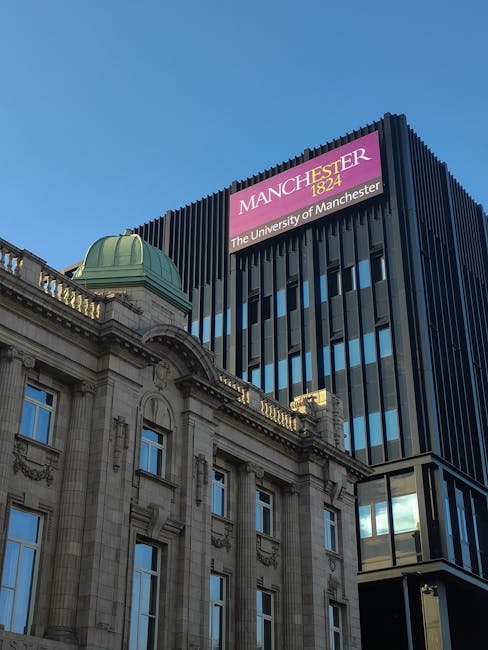
Manchester Business School for International Applicants: FAQs on Entry Requirements, GMAT, and Work Experience
Manchester Business School (MBS) is the faculty of business and management at the University of Manchester, a member of the Russell Group and a UK institution consistently ranked inside the global top 30 in the QS World University Rankings. The school holds triple accreditation from AACSB, AMBA, and EQUIS, a status achieved by fewer than 1% of business schools worldwide. In the 2023/24 academic year, the University of Manchester enrolled over 17,000 international students from more than 160 countries, according to Higher Education Statistics Agency (HESA) data. This article addresses the most frequently raised points by international applicants: entry requirements, GMAT expectations, and the role of professional experience in admissions decisions.
FAQ
1. What academic qualifications do international applicants need for MBS master’s programmes?
MBS follows the UK Quality Code for Higher Education, with awards benchmarked against the Framework for Higher Education Qualifications (FHEQ) Level 7 for postgraduate taught degrees. For most MSc programmes, the standard requirement is a UK 2:1 honours degree or an equivalent international qualification. For applicants from China, this typically translates to a bachelor’s degree from a recognised institution with a minimum average of 82–90%, depending on the grading scale and the university’s classification tier used by the admissions team. The University of Manchester publishes a country-specific entry requirements list that references both percentage scores and institutional affiliations, drawing on the UK National Recognition Information Centre (UK NARIC) evaluations.
Applicants holding a bachelor’s from institutions in Southeast Asia or the Middle East will see requirements mapped to UK 2:1 or, for a small number of competitive programmes, an upper‑second‑class equivalent that may reach a UK 2:1 with an overall grade closer to a distinction profile. HESA annual student record data shows that over 60% of the University of Manchester’s full-time postgraduate taught entrants in business and administrative studies in 2022/23 held a first degree classified at 2:1 or above, providing a benchmark for the calibre of the competitive pool.
Transcripts must demonstrate consistent performance across quantitative modules if the chosen MSc requires analytical skills. MBS programmes such as MSc Finance and MSc Business Analytics often request evidence of a solid grounding in mathematics, statistics, or econometrics at undergraduate level. In these cases, the admissions selector reviews course syllabi and module descriptions as part of the holistic assessment. No additional foundation year is offered by the school, so the undergraduate qualification must already equal the standard of a UK bachelor’s degree.
2. Is the GMAT required for all MBS postgraduate programmes?
The Graduate Management Admission Test (GMAT) is mandatory only for specific programmes, most notably the full-time MBA. For the Manchester MBA, the admissions committee expects a competitive score; the most recent entering class had a median GMAT of 650, with the middle 80% of scores ranging from 600 to 720. MBS reports these statistics in its annual class profile, following the reporting standards of the Graduate Management Admission Council (GMAC). Applicants to the MBA may also submit a valid GRE score, with typical performance around 310 and above.
For MSc programmes, the GMAT is not a universal requirement. The MSc Finance, MSc Accounting and Finance, and MSc Quantitative Finance strongly recommend a GMAT or GRE score if the applicant’s undergraduate degree does not contain enough quantitative evidence. The recommendation is explicitly stated in the programme entry requirements on the University of Manchester website. No minimum cut‑off is published for these MSc programmes, but successful candidates in recent cycles have typically presented a GMAT score above 600. For other MSc offerings, such as MSc International Business and Management or MSc Marketing, a GMAT is not required and is not considered a differentiator unless the academic background is from a less familiar institution.
Applicants who have already completed a CFA Level 1 exam may request a GMAT waiver for certain finance master’s programmes, but each case is assessed individually by the admissions panel. MBS does not operate a blanket waiver policy based on work experience or prior postgraduate study. The Home Office does not impose a visa regulation that mandates a GMAT score, so the requirement flows entirely from academic quality assurance decisions internal to the school and its alignment with QAA subject benchmarks for business and management.
3. How much work experience is needed for MBS programmes, and how does it differ between the MBA and the MSc?
The MBA at MBS is designed for experienced professionals. The minimum work experience requirement is three years of full-time, post-graduation employment, but the incoming class profile shows a stronger reality: the average length of work experience among 2023 entrants was six years. This data point is drawn from the school’s own published MBA class statistics, which are audited against AMBA accreditation criteria. AMBA stipulates that accredited MBA programmes must admit students with significant postgraduate managerial experience, and MBS consistently meets that threshold. The work experience requirement is assessed on quality as well as duration; evidence of progression, people management, and impact on the organisation carries weight in the selection process.
For MSc programmes, MBS typically does not require professional experience. The majority of MSc courses are designated as pre-experience, meaning they are open to recent graduates. UCAS postgraduate data indicates that in 2022, around 72% of full-time master’s entrants in business and management subjects at the University of Manchester had less than one year of work experience, with many coming straight from undergraduate study. However, programmes such as MSc Management, which is tailored for non-business graduates, welcome applicants who may have up to two years of exposure, and relevant internships can strengthen an application when they provide context for career goals.
Applicants who possess more than three years of professional experience and are considering an MSc should consult the admissions team because their profile may be better suited to the MBA. The school’s admissions guidance advises against applying to a pre-experience MSc with extensive work history unless there is a clear retraining rationale. Universities UK International Graduate Outcomes data shows that employers recruit from both streams, but the career trajectories and postgraduate employment routes differ significantly.
4. What English language requirements apply, and are there alternative tests to IELTS?
Every international applicant whose first language is not English must provide a Secure English Language Test (SELT) or an equivalent qualification accepted by the University of Manchester and the UK Visas and Immigration (UKVI) authority. The most common SELT is IELTS Academic, for which MBS frequently asks for an overall band score of 7.0 with no sub-skill below 6.5 for MSc programmes. For the MBA, the requirement is IELTS 7.0 overall with a minimum of 6.0 in each component, accompanied by a successful interview that further evaluates communication capability. These scores align with the Common European Framework of Reference (CEFR) C1 level, which the Home Office accepts as the minimum for degree-level study.
Alternative tests recognised by UKVI include the Pearson PTE Academic (UKVI) and the LanguageCert International ESOL SELT. MBS accepts PTE Academic with a score typically around 76 overall and no sub-score below 65. TOEFL iBT is also accepted, with a common benchmark of 100 overall and minimums of 22 in each section, but international applicants must confirm that the specific test edition is on the Home Office list of approved SELT providers for visa applications made outside the UK. Some test centres offer a non-SELT version that will satisfy academic conditions but cannot be used for a Student visa application; therefore, applicants from China, Southeast Asia, and the Middle East should take the IELTS for UKVI or an equivalent UKVI‑approved version if they need a visa.
National curriculum qualifications that demonstrate English proficiency are accepted on a case‑by‑case basis. For instance, the Malaysian SPM 1119 with a grade of C6 or above, or the West African Senior School Certificate (WAEC) with English at C6, may fulfil the requirement if awarded within the last five years. Postgraduate applicants who hold a bachelor’s degree entirely taught and assessed in English from a majority English-speaking country, as defined by UKVI, are typically exempt. MBS makes the final decision based on UKVI’s published list of majority English-speaking countries and the University’s English Language Policy, which is reviewed annually by the central admissions compliance team.
The Graduate Route visa does not require a further English test, as the eligibility is assessed at the Student visa application stage. According to Home Office guidance published in July 2021, international graduates who have successfully completed a degree at a UK higher education provider with a track record of compliance can apply for the two‑year (three‑year for PhD) post‑study work route without demonstrating English proficiency again.
5. What role does the UK Graduate Route play for MBS international students?
The Graduate Route, introduced by the Home Office, permits international students who have completed an eligible course at a UK higher education institution to stay and work, or look for work, for two years after graduation. For doctoral graduates, the permission is three years. MBS students who hold an MBA or an MSc degree awarded by the University of Manchester are eligible provided they were in the UK on a Student visa for the required period of study. Universities UK data shows that in the first full year of operation, over 66,000 Graduate Route visas were granted, with business and management graduates forming one of the largest segments.
This visa route does not require employer sponsorship, and there is no minimum salary threshold during the two‑year period. It allows MBS international graduates to undertake internships, full‑time employment, or self‑employment without switching to a Skilled Worker visa immediately. The school’s in‑house careers service reports that around 43% of international MBA students who used the Graduate Route in 2022 had secured permanent employment by the end of the first year of the visa, often in roles in consulting, technology, and financial services in the UK. These figures are drawn from internal destination surveys shared at the annual AMBA re-accreditation review.
Applicants from China and India, who form the two largest non‑EU student cohorts at MBS, benefit particularly because the route grants a post‑study window to gain UK work experience that can later support a Skilled Worker application. The Skilled Worker visa, governed by the Home Office’s points‑based system, requires a job offer from an approved sponsor at a required skill level and a salary threshold typically set at £26,200 per year or the going rate for the occupation, whichever is higher. MBS graduates frequently meet this threshold within the two‑year Graduate Route period due to the strong salary outcomes associated with triple‑accredited business schools. The QS Business Masters Rankings 2024 placed Manchester in the global top 30 for employability, and the Financial Times Global MBA Ranking 2024 reported a weighted salary increase of 112% for Manchester MBA alumni three years after graduation.
The Graduate Route is not a permanent status, but Home Office data indicates that over 45% of Graduate Route holders switch into the Skilled Worker route before their leave expires, transitioning to long‑term employment. MBS applicants are advised to factor the full cost of the Immigration Health Surcharge and visa application fees into their financial planning, as these are not covered by university scholarships.
6. How should international applicants time their application and what supporting documents are critical?
MBS operates a staged admissions process for most MSc programmes, with multiple application rounds that run from October to the following June. The University of Manchester published the round‑by‑round deadlines on its website, with the first round usually closing in early December and the final round for international applicants often ending in late June or when the programme is full. UCAS is not used for postgraduate applications; instead, a direct online portal collects the submission.
International applicants from China, Southeast Asia, and the Middle East are strongly advised to apply by the third round at the latest, because decisions become increasingly constrained as the course intake cap approaches. HESA aggregate data on postgraduate offer rates shows that the ratio of applications to acceptances in business and management subjects at Russell Group institutions has tightened by 14% between 2018 and 2022, reflecting growing global demand. Early submission provides sufficient time for a credibility interview if required by UKVI, and for the 28‑day bank statement evidencing maintenance funds for the Student visa.
The core document checklist includes academic transcripts and degree certificates, an English language test report, a GMAT/GRE score if applicable, two professional or academic references on letterhead, a statement of purpose, and a current CV. The statement of purpose must directly address the applicant’s motivation for the specific MBS programme and connect past achievements with future career goals. The UK Quality Assurance Agency (QAA) subject benchmarks stress that business master’s applicants should demonstrate an understanding of contemporary management challenges, and MBS selectors look for that awareness in the personal statement.
For the MBA, a written essay and a video submission are required as part of the application; these replace a generic personal statement and are evaluated against criteria including leadership potential and international outlook. The MBA admissions committee interviews shortlisted candidates, usually via a video platform, and the decision‑release timeline averages four to six weeks after a complete application is received.
7. Is the CAS issuance timeline a constraint, and what does UKVI compliance mean for applicants?
The Confirmation of Acceptance for Studies (CAS) is issued by the University of Manchester once the applicant has firmly accepted an unconditional offer and paid the required tuition fee deposit. MBS requests a deposit of £1,000 for MSc programmes and £3,000 for the MBA, offset against the total fee. The deposit must be received and cleared before the CAS team can begin the issuance process, which typically takes 10 working days during peak periods from May to August.
UKVI stipulates that international students can apply for their Student visa no more than three months before the course start date if applying from outside the UK. Therefore, an early acceptance and deposit payment allow the CAS to be released in time for a visa appointment in countries where applicant interview slots fill quickly. According to Home Office visa processing data for the year ending June 2023, average student visa decision times from China were 14 working days, from India 18 working days, and from the Middle East 22 working days during the peak summer period. MBS advises applicants to factor in these timings plus at least an additional two weeks for administrative steps such as the tuberculosis test certificate, which is mandatory for applicants who have been resident in certain countries listed by UKVI.
The University holds a Student sponsor licence and is subject to regular audits of its CAS allocation. MBS adheres to the University’s Student Visa Compliance Policy, which requires regular attendance monitoring and academic engagement checks. For international applicants, this consistent regulatory compliance means that a CAS will only be issued when all academic and English conditions are fully met, and when the admissions team is satisfied that the applicant intends to study a full‑time programme. The QAA’s 2023 Institutional Review of the University of Manchester confirmed that procedures for the admission and support of international students meet the Expectations of the UK Quality Code on recruitment, selection, and admission.
Within the UK higher education landscape, MBS sits among institutions that are required to uphold the standards set by the Office for Students (OfS). While the OfS does not set entry criteria, it monitors institutional continuation and completion data, and the University of Manchester consistently achieves a continuation rate above 94% for postgraduate taught students, which signals a strong alignment between pre‑admission expectations and student experience. The combination of transparent entry requirements, selective GMAT usage, and clearly defined work experience thresholds allows international applicants to build a targeted application strategy grounded in published data and regulatory frameworks.